Schools work to improve vision health
 Credit: Jane Meredith Adams/ EdSource Today
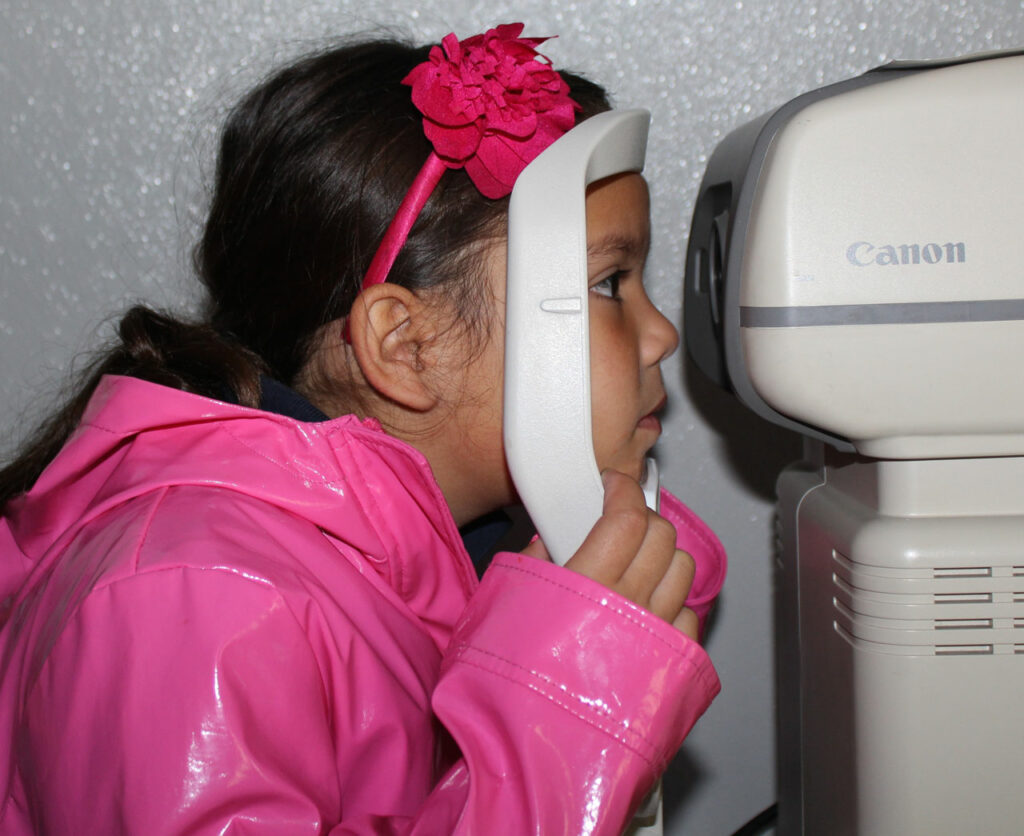
A San Jose student receives an eye test from Vision to Acquire.
It was a good calendar week for the 90 students at Merritt Trace Unproblematic School in San Jose who climbed into a mobile center exam van and emerged with the promise of a free pair of eyeglasses. Just for thousands of students beyond the state who demand glasses simply don't have them, it was another blurry week of not seeing the blackboard or the letters in a volume.
Effective Jan. 1, two new state laws will clarify and expand the protocol for mandatory vision screening of students, but they don't address the crux of a major children's wellness conundrum: ensuring that students who fail the vision test actually become eyeglasses.
As many as one in 4 students in kindergarten through twelfth grade has a vision problem, according to the American Public Health Association, but in some California schools, the majority of students in need of glasses don't receive them, researchers said. In a 2022 written report of eleven,000 depression-income 1st-graders in Southern California, published in the Periodical of Public Health Management and Exercise, 95 percent of students who needed eyeglasses didn't take them, one year afterwards their mandatory kindergarten vision screening.
"You would hope that the problems would have been caught," said Dr. Anne Coleman, a co-author of the report and an ophthalmologist at UCLA's Jules Stein Eye Establish.
But bridging the gap betwixt a failed vision test and a student with glasses on – ready to see the math problem on the board, the words in the book and the baseball coming over the plate – has been a difficult task. Increasingly, schools and nonprofit organizations are working together to become beyond mandatory vision screening to help low-income students obtain the glasses they need to succeed.
"What nosotros need is a systematic arroyo," Coleman said.
Screening of educatee vision is mandatory in California schools and the new police force, Senate Bill 1172, authored by country Sen. Darrell Steinberg, D-Sacramento, adds the requirement that a student'due south near vision be tested, in addition to far vision. The law also makes patently that vision screening is required in kindergarten, or when a educatee first enters a schoolhouse district, and in second, 5th and 8th grades – a change from the previous language that required vision testing upon entry and thereafter "at least every three years."
"What nosotros need is a systematic approach," said Dr. Anne Coleman, an ophthalmologist at UCLA'southward Jules Stein Eye Establish.
The second new law, Assembly Bill 1840, authored by land Assemblywoman Nora Campos, D-San Jose, allows the utilise of "photoscreening" – a handheld device that detects vision bug – as well as the utilize of an eye chart in a student vision screening. The device costs about $7,000.
Inquiry has shown that the consequences of impaired vision are far-reaching for students, including underachievement, detachment and behavior problems, said Charles Basch, professor of wellness and education at Teachers College of Columbia University. Because nearly learning occurs visually, and depression-income students are at greater take chances of "underdiagnosis and undertreatement" of vision problems, getting spectacles on students needs to be part of school reform efforts to ameliorate academic outcomes, said Basch, writer of the research cursory "Healthier Students are Ameliorate Learners: A Missing Link in School Reforms to Shut the Achievement Gap."
Different dental decay and asthma, vision bug are not associated with student absences and the correlating loss in revenue for school districts, which receive funding based on Average Daily Attendance.
"It's a need that has a pretty simple solution to it," said Nancy Prail, director of ChildSight, a program of Helen Keller International, a New York-based nonprofit organization that in 2013-14 performed vision screenings and eye exams on sixteen,800 middle schoolhouse students in the Los Angeles area, with 2,543 pairs of eyeglasses provided.
After a educatee fails to read the eye nautical chart in a vision screening conducted by a school nurse, a letter is typically sent home informing the family unit of the results and stating that the child needs a more in-depth eye examination. In low-income families, following through on that referral is often difficult, Prail said.
"There's a whole stew that gets stirred up," Prail said, including a family unit's difficulty in finding a provider that will have Medi-Cal and the inability to take time off work to bring a child to an appointment.
Bringing clinicians to schools is a way to overcome those barriers, Prail said. Some schoolhouse-based health centers provide the exams and several nonprofit organizations are working with schoolhouse districts to send optometrists and mobile heart test vans to schools in California, including ChildSight, Vision to Learn, Encounter Well to Learn and VisionFirst.
In the San Jose Unified Schoolhouse District, a new partnership with Vision to Learn, a Los Angeles-based nonprofit system that provides complimentary eye exams and gratis spectacles to children in low-income communities, has simplified the process of getting glasses on students, said Melinda Landau, manager of the Health and Family unit Support Programs at the district.
For iv rainy days final calendar week, the 15-foot Vision to Acquire mobile middle exam van was parked exterior a portable classroom at Trace Elementary while a parent volunteer shepherded groups of three or four students across the tarmac and into the world of center examination machines and best of all, a brandish case of cerise, regal, blue and black eyeglass frames from which to cull.

Credit: Jane Meredith Adams/EdSource Today
The Vision to Learn mobile eye exam van at Trace Unproblematic in San Jose. Credit: Jane Meredith Adams/EdSource Today
"I lost my spectacles in 1st form," said Camielle Toscano, a 2nd-grader at Trace Elementary, who saturday in pelting boots and a rain jacket waiting for an eye examination in the van.
At the back of the van, optometrist Dr. Chris Low slid lenses of various magnification strengths into a auto as Keiasia Johnson, a 1st-grader, looked through the lenses and read an heart chart.
Pleased by the ability to run into that the examination lenses gave her, Keiasia said, "They expect fine when I have my spectacles on." Stepping to the other stop of the van, Keiasia tried on a diversity of eyeglass frames with the assist of optician Lisa Nguyen before settling on pink. Nguyen will return to Trace Elementary to deliver and fit the eyeglasses on students in two to three weeks.
Because school partnerships with nonprofit organizations are dependent upon philanthropic fundraising and priorities, the search for sustainable vision intendance for students is ongoing. With more California children entitled to pediatric vision services through the Affordable Intendance Act and the expansion of Medi-Cal, one strategy is to pecker insurance for the care that is provided at the school site. Gov. Jerry Brown authorized grants that total about $1.v million available Jan. i in Los Angeles County to pilot examination the creation of a database arrangement to connect student on-site vision care with insurance billing, said Gaye Williams, executive director of Vision to Learn, which plans to apply for a grant.
In the San Jose Unified School District, a five-twelvemonth "Putting Healthcare Back into Schools" Nurse Demonstration Project through the Stanford University School of Medicine Schoolhouse found that the presence of a full-fourth dimension school nurse increased the number of students receiving follow-up eye exams and center glasses. The rate of follow-up was "almost 100 pct in schools, if they had a total-time nurse," Landau said.
Full-time school nurses see the families, know the students and piece of work with the teachers to ensure that appointments are made, spectacles obtained and spectacles worn in class. The nurses also act equally a liaison with groups, such equally the service organization the Lions Club, that provide vouchers for free centre exams and glasses. "In that location was time and attention put on it," Landau said.
At present Landau is working to collect data on the affect of glasses. "We demand to track these kids to find out — do we see improvement in academics?" she said.
To get more reports like this i, click here to sign up for EdSource'southward no-cost daily email on latest developments in teaching.
Source: https://edsource.org/2014/schools-work-to-improve-vision-health/71044
0 Response to "Schools work to improve vision health"
Post a Comment