Tell Me, Don’t Sell Me: Modern Political Advertising's Failings
Tell Me, Don't Sell Me
Just recovering from the shallowness of the main season's political advert? You ain't seen naught yet
Tell Me, Don't Sell Me
Just recovering from the shallowness of the primary season's political advertising? You own't seen cypher nevertheless
Jun. 09, 2016


About a week before Apr's chief election, I sat beyond from a candidate for Congress who had his head in his hands. We were having drinks, and Rev. Neb Golderer, running for the Democratic nomination in the seventh Congressional District, pulled out of his pocket the script for a radio ad written for him by a loftier-priced D.C. consultant. Golderer was to record the ad in the forenoon, only now he was having doubts.
"Okay, and so information technology begins with zoo animal noises and then an announcer says, 'It's like a zoo in Congress, nothing gets done,'" he said, pausing to look at me.
"Animal noises?" I asked.
"Fauna noises," he said. "And then my voice comes in, saying 'I'm Bill Golderer, and I know we need to fix this broken arrangement.'"
He paused, looking at the paper. So he continued. "Dorsum to voiceover. 'Nib Golderer was raised in Wayne by a difficult-working father, and a mother committed to customs service,'" he read, earlier stopping and looking at me. "Uh, kinda, but non actually."
What Golderer was reacting to was the advert's lack of nuance. "It'southward all true," he said, merely not real. Hah. Dude, I said, that'southward your advert. He looked perplexed. "Read the script and comment on it, like y'all only did," I said.
"Yep," he said, getting excited. "I could say, 'This is what the D.C. political professionals desire me to say. Just it sounds like every bad political ad I've ever seen!'"
As a lark, we imagined a revamped ad, that would accept Golderer go on to say, "Hither's the truth: I'thousand a pastor and a social entrepreneur who has spent the concluding two decades trying to solve bug in real people's lives. I founded Broad Street Ministry and Rooster Soup, a eatery that gives all its profits to clemency…If you're ready for something completely different, come take back the Capitol with me. I'm Nib Golderer and this actually is my bulletin."
The drinks kept coming every bit we kicked effectually an idea for a political ad that wasn't cookie-cutter or otherwise lame; something that was real. A few days later, nevertheless, the zoo tamer version ran. A few days after that, Golderer lost to Mary Ellen Balchunis. Information technology wasn't even close. Last calendar week, I caught up with him for dinner and drinks.
What happened?
"Ultimately, you come against the tension betwixt what you're told is effective, versus what you call up is important," Golderer said. "Equally a starting time-fourth dimension candidate, you don't know what you don't know. I looked to experienced political people to assistance me figure out how to introduce myself and say who I am in the 10 seconds you lot have to catch someone's attention. I ran because I wanted to talk nearly things that were of import, which I had a plan to practice in the full general election. But information technology turned out the conventional wisdom was wrong and I never got the adventure." (That said, I was struck past how cheerful Golderer seemed after the feel. "I met some awesome people," he exclaimed.)
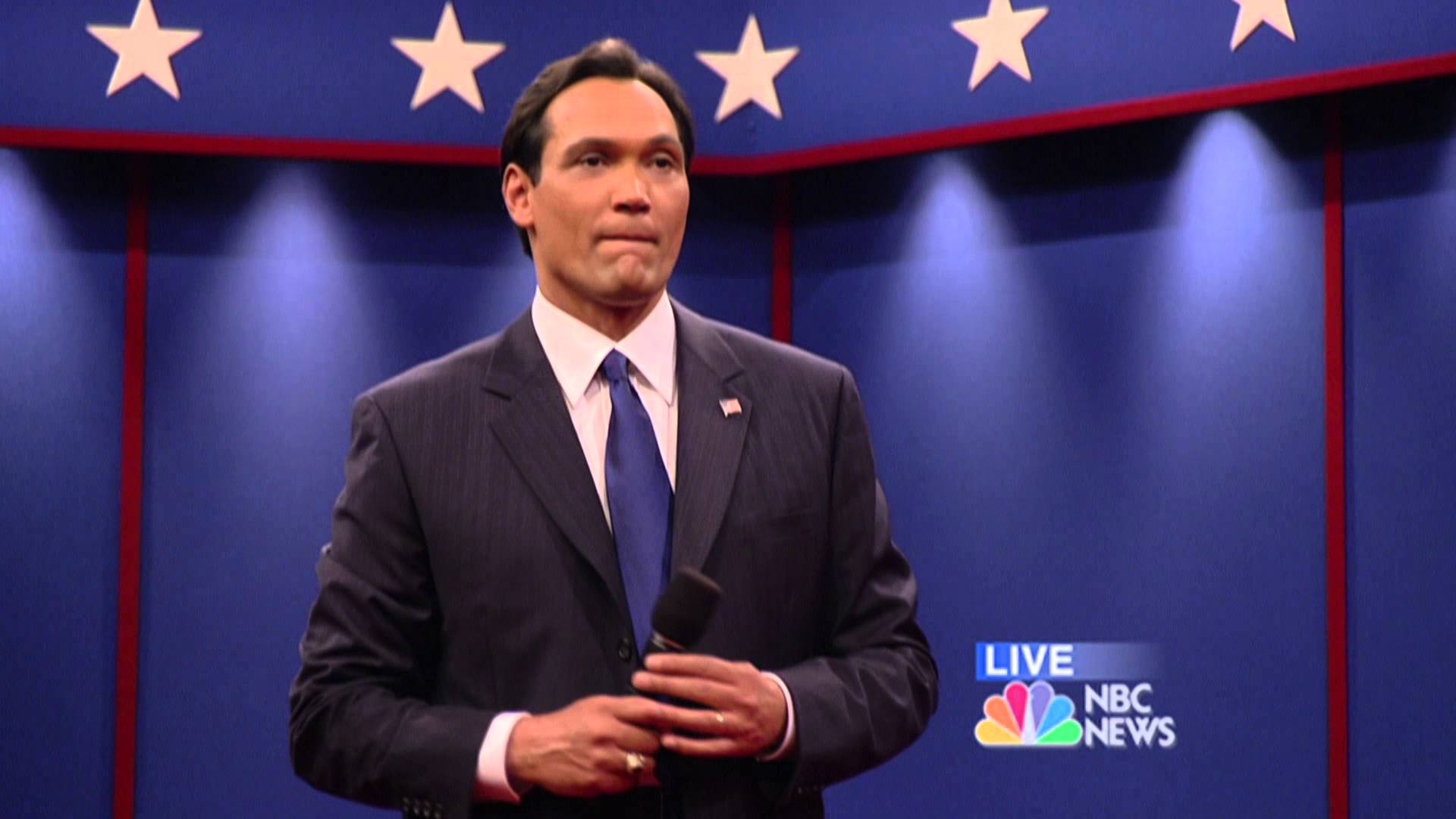
Golderer found himself starring in his own Matt Santos moment. Santos was the fictional Congressman in The Due west Wing played by Jimmy Smits who, running for president for all the correct reasons, realizes that political campaigns have little to do with those reasons. "You get into this, thinking to yourself that yous're going to play by your own rules and then, chip by bit, you chip away at them until you tin't even name the game," he says, before daring to go live and speak from the heart directly to the voter:
Information technology's a terrible indictment of our system, isn't it? Golderer, who ran saying he sought to restore a sense of spirit and soul to our political life, came face up to face with a hard reality: Our campaigns are actually well-nigh nothing. Inspiration? Aspiration? Political ads that strive for those lofty heights would seem to have become as extinct as bipartisanship and centrism. After each election season, information technology feels like we demand to recover from the onslaught of insipid letters we're bombarded with. No wonder so many stay home on election 24-hour interval—between the name-calling and the cheesiness of how our campaigns play out on TV, a "pox on both their houses" mindset has taken concord.
Much has been written almost the ill furnishings negative political advertizing has on our civic life, only I suspect that what's just every bit damaging to the body politic is stupid advertisement. Congressional campaigns that accept smart, well-intentioned candidates and have them calling Congress a zoo—complete with barnyard animal noises—do nothing but contribute to the dumbing down of our public life. But, equally the consultant grade has risen—in the last few decades, the ad men and women behind our candidates, from James Carville and Mary Matalin to Karl Rove and David Axelrod, have become stars—candidates have establish themselves less and less in control of their own bulletin. They're the actor, not the director, of their own play. (It could also legitimately be argued that the quality of today'southward candidate is lesser than it once was, making his or her bulletin more malleable).
"It'south all a blur to the consultants," says longtime, legendary advertizing human being Elliott Curson, who did Ronald Reagan's advertising in 1980 and who, fable has it, came up with one of Philadelphia'southward great tag lines in promoting Arlen Specter for Commune Attorney and Tom Gola for Controller in 1969— They're younger, they're tougher, and nobody owns them —and who coined the edgy line Philadelphia isn't equally bad as Philadelphians say it is on a Schuylkill Superhighway billboard in the '70s. "The manner it by and large works, you become some stock footage, become the candidate at a senior citizens eye, testify him or her with their family. Sew together something together with a line or ii. Or y'all darken a photo of the opponent and have the discussion 'Corrupt' stamped onto the screen in big red messages. The spots don't have to be good—y'all just have to have a lot of them. What's missing is respect for the audition."
There are exceptions, of form. Locally, in 2007, Neil Oxman—one of the most successful practitioners of the art of political ad—produced Michael Nutter's Olivia advertizing, narrated by the candidate'due south daughter:
In the early on '90s, an obscure professor in Minnesota, eschewing within the Beltway political advertizement-makers for North Woods Advert, a local agency, aired entertaining and creative commercials en route to a stunning political upset and a seat in the United states of america Senate:
What do all of these examples of transformative political advertising have in common? They're all creative, entertaining, inspirational and aspirational. They are the opposite of the cookie-cutter approach Curson alludes to, the one with which we're all likewise familiar. They tell a story. George Lois, the legendary Mad Homo era ad human, didn't practice a lot of political ad but said that there is niggling difference between selling a product like MTV, which he did with his "I want my MTV" campaign, and selling a politico. Both need an animating idea. "You lot can name hundreds of products that spend millions a year on advertising, but what's the thought?" He once said. "Yous gotta come up with an thought ."
In this most contempo election, there was an advertising—I saw it locally on cable—that got across an aspirational idea. It was an ad that was dissimilar, that fabricated you accept observe. Check it out:
Notice the silent stretches—there's no voiceover yelling cliches at yous—and the uplifting music, the looking-forrad tag line. Conspicuously, this is an ad that opted for inspiration over crass manipulation. Turns out, this commercial for State Representative Mike O'Brien was an Elliott Curson articulation. "Over dejeuner, Mike mentioned in passing that he'd gotten funding for the Track Park," Curson says. "I said, 'That'southward amazing.' I dearest the Loftier Line in New York and I thought this could represent the opening up of a whole new neighborhood for the city. I was and so excited, I storyboarded it and sent information technology to Mike."
On election day, Curson says he went to polling places in Society Hill, Queen Hamlet, Kensington and Mayfair and talked to voters about the advert. "I had people tell me, 'You weren't selling me something, you were telling me something," he says.
In the making of the ad, Curson was resolved to keeping it simple. He focused on making it well-nigh i thing: What could be . Just recall about how elevated our political life—and the metropolis itself—could get if that approach became the norm?

Source: https://thephiladelphiacitizen.org/political-advertising-bill-golderer/
0 Response to "Tell Me, Don’t Sell Me: Modern Political Advertising's Failings"
Post a Comment